My Newt Is Gone Again: The Surprisingly Deep Reason Your Pet Keeps Pulling a Houdini
It happens to the best of us.
You wake up on a Tuesday morning, shuffle into the kitchen for a glass of water, and notice the tank lid is slightly ajar. You peer inside. The little plastic log is there. The rocks are there. The carefully measured dechlorinated water is there.
Your newt, however, is absolutely not there.
Cue the frantic search. Under the couch. Behind the bookshelf. Inside a shoe (it happens). And when you finally locate the little guy — damp, unbothered, and somehow looking smug — you find yourself asking the same question every newt owner eventually asks: Why do you keep doing this?
The answer, it turns out, is one of the most quietly wonderful things about these tiny, ancient creatures. And it just might teach your kid something important about being alive.
They Were Built to Wander
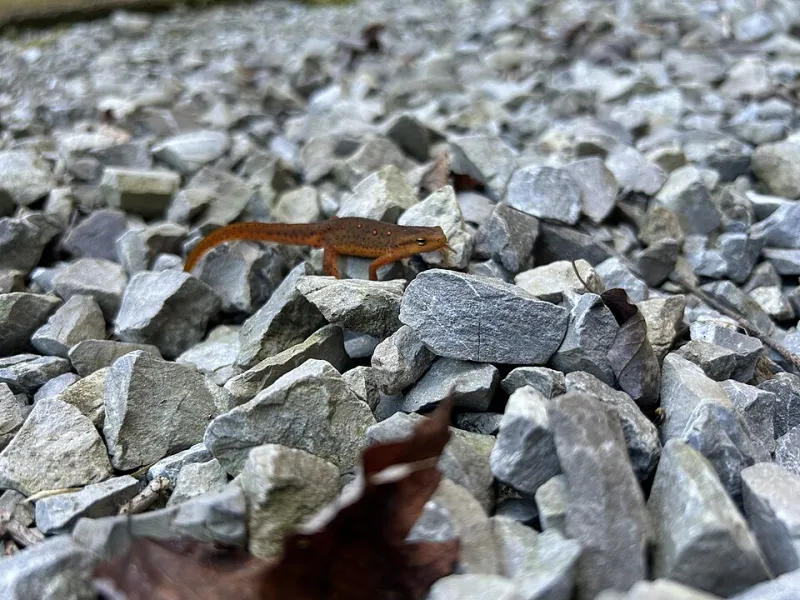
Here's the thing about newts that doesn't get nearly enough attention: these animals are, at their biological core, travelers. In the wild, newts don't just sit in one pond and call it a life. Many species — including the Eastern Newt, one of the most common pet newts in the United States — go through a remarkable life stage called the eft phase, during which they leave the water entirely and spend years roaming forests on foot. On foot! Tiny orange feet, trekking through leaf litter and underbrush like the world's smallest, slimiest backpacker.
During this terrestrial phase, Eastern efts have been documented traveling hundreds of feet from their home ponds. For an animal that fits in the palm of your hand, that's an extraordinary distance. It's the equivalent of a human walking from New York City to Los Angeles and thinking, yeah, this feels about right.
When you put a creature like that in a glass box — even a really nice glass box with a great rock — some part of its ancient brain is going to whisper: there's more out there. And that whisper is hard to ignore.
The Engineering of a Great Escape
Newts are not just motivated to escape. They are genuinely, impressively good at it.
These amphibians can scale vertical glass surfaces by exploiting microscopic imperfections and moisture. Their bodies are flexible enough to squeeze through gaps that look impossibly small. They're patient. They're methodical. They will find the one corner of your lid that doesn't quite close flush and they will exploit it with the quiet confidence of a creature that has approximately 350 million years of evolutionary experience behind it.
They also have a biological incentive that goes beyond simple wanderlust. Newts are sensitive to changes in barometric pressure, humidity, and temperature — meaning they can sometimes sense weather changes, seasonal shifts, or environmental cues that we can't detect at all. When a newt starts pushing at the walls of its tank, it may genuinely be responding to something real. A storm coming. A shift in the season. The pull of some internal compass that no amount of dechlorinated tap water can fully override.
That's not misbehavior. That's instinct. That's listening to something deep and true.
What Your Kid Can Learn From a Tiny Escape Artist
Here's where it gets good.
Kids and newts have more in common than you might think. Not in the slimy, cold-blooded sense (usually). But in the sense that both are constantly bumping up against boundaries — the edge of the yard, the rules of the classroom, the limits of what they're allowed to do on their own — and feeling that same quiet pull toward more.
That restlessness isn't a problem. It's information.
When your newt escapes, it's not being bad. It's being exactly what it is: a creature designed by millions of years of evolution to explore, to move, to respond to the world around it. And when your kid wants to wander a little farther down the trail, try the harder bike path, or spend an afternoon turning over rocks in the creek — that's the same impulse, wearing different shoes.
The lesson isn't ignore all boundaries and do whatever you want. The lesson is: curiosity is not a flaw. The desire to see what's around the next corner is one of the most valuable things a person (or a newt) can have.
Practical Stuff, Because Your Newt Actually Needs to Stay Hydrated
Okay, we've been poetic about it, but let's be real: a newt that escapes its tank is also a newt that can dry out, get lost, or end up somewhere genuinely dangerous. So while we celebrate the spirit of adventure, we also want to keep the adventurer safe.
A few things that actually help:
Get a lid that locks. Mesh lids with locking clips are your best friend. Newts are strong for their size and will push on a loose lid until something gives.
Check the humidity. If a newt is desperately trying to escape, it may be because the environment inside the tank isn't quite right — too dry, too warm, or not enough water coverage. A comfortable newt is a slightly less escape-prone newt.
Give them enrichment. Rocks to climb, hides to explore, plants to navigate around. A newt with things to investigate inside the tank is a newt that's at least partially distracted from the outside world.
Know your species. Eastern Newts, Fire Belly Newts, and Paddle-tail Newts all have different habitat needs. A setup that's perfect for one might feel all wrong for another.
And if your newt does escape? Don't panic. Stay low, move slowly, and check warm, dark, damp places first. They almost always turn up.
The Tiny Philosopher Behind the Refrigerator
There's something genuinely moving about a creature so small, so ancient, and so absolutely committed to the idea that the world is bigger than its current container.
Your newt doesn't know about philosophy. It doesn't know it's inspiring anyone. It's just doing what newts do — pressing forward, finding the gap, following the pull of something it can't quite name.
But maybe that's exactly the kind of role model a kid needs. Not a superhero. Not a champion. Just a small, determined, wonderfully weird little animal that keeps looking for the door.
And when it finds one? It goes.