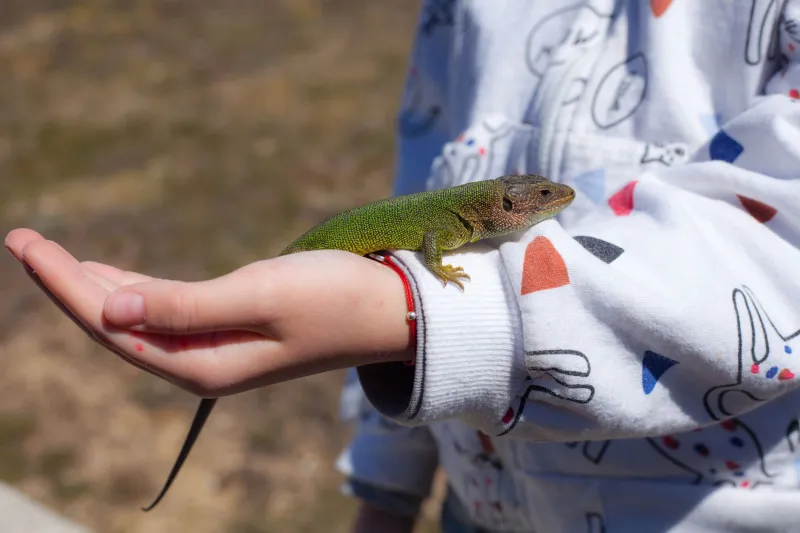
What Is Your Newt Trying to Tell You? A Kid's Crash Course in Amphibian Body Language
Let's get one thing straight: your newt is not just sitting there doing nothing.
Yes, from across the room it might look like a small, motionless blob of olive green with the personality of a decorative rock. But zoom in — really zoom in — and you'll discover that your newt is basically narrating its entire inner life through a series of tiny, highly specific physical cues. Tail position. Skin texture. The exact angle at which it's pressing itself into the corner of its tank. These are not random. These are messages.
The trick is learning how to read them. And here's the beautiful part: kids are actually really, really good at this. Better than most adults, honestly. Because kids haven't yet been trained to ignore small, weird things. They still notice everything.
So let's turn that superpower into something official. Welcome to the unofficial, totally-legitimate-in-our-hearts field guide to newt body language — written for the smallest animal behaviorists among us.
First, Why Newts Communicate Differently Than Dogs or Cats
When a golden retriever is happy, it pretty much announces it to the entire neighborhood. Tail wagging, jumping, the whole theatrical production. Cats are more subtle, but they still meow, purr, and knock your water glass off the counter with unmistakable intention.
Newts are operating on a completely different frequency.
As amphibians, they've spent hundreds of millions of years communicating through posture, movement, and even chemical signals rather than sound or dramatic facial expressions. They don't have the same muscle structure for "faces" that mammals do. What they have instead is a whole-body communication system that rewards patient, careful observers.
This is actually great news for kids. Because it means your kid has to slow down and pay attention — two skills that happen to be incredibly useful in approximately every other area of life.
The Tail Tell: What's Going On Back There
The tail is your newt's most expressive real estate. Start here.
A relaxed, gently curved tail trailing behind your newt as it cruises around the tank? That's a content newt. A comfortable newt. A newt that has decided today is fine, actually.
A stiffly raised or arched tail — especially combined with a slightly hunched posture — is a different story. In many newt species, this is part of what scientists call the "unken reflex," a defensive pose that basically says: Back off. I am unpleasant and possibly toxic and you will regret this. It's the newt equivalent of puffing up. Teach your kid to recognize this one fast, because it means the newt is stressed and needs some space.
A rapidly flicking or vibrating tail during what looks like a slow-motion dance? Congratulations — you may be witnessing newt courtship behavior. It's simultaneously one of the most elegant and most ridiculous things in the animal kingdom, and kids absolutely love it.
Skin Signals: Reading Between the Scales (Sort Of)
Newts don't have scales, technically — they have smooth, moist skin. And that skin is actually a surprisingly useful mood indicator.
Many newt species, including the popular Eastern red-spotted newt found across the eastern United States, can show subtle color changes or texture shifts depending on their health and stress levels. A newt that looks duller than usual, or whose skin appears unusually dry or patchy, might be telling you something important about its environment — temperature, humidity, or water quality.
A healthy, happy newt has skin that looks alive — vibrant, moist, and the specific shade of "I am thriving in here." Encourage your kid to make a habit of checking in on this regularly. Not obsessively, but the way a good friend checks in. "Hey, you look good today. Skin's looking great. Very moist. Love that for you."
This kind of regular observation is also how kids learn to catch health issues early, which is genuinely important for responsible pet ownership.
The Freeze: When Stillness Is Actually a Sentence
Here's one that trips people up: sometimes a newt goes completely, eerily still. Not the lazy "I'm resting" kind of still. The rigid, statue-like, I have decided I am invisible kind of still.
This is almost always a stress response. Something in the environment — a sudden noise, a shadow passing overhead, a curious face pressed against the glass — has triggered your newt's ancient "do not move and maybe the predator will leave" instinct.
Teach your kid that this stillness is a form of communication. The newt is saying: Something scared me. I need a minute. The appropriate human response is to back up, lower the stimulation, and give the little guy a chance to recalibrate. This is an excellent lesson in reading someone else's discomfort and responding with patience instead of pushing harder — a skill that translates beautifully to human friendships.
Active and Curious: The Good Stuff
Now for the fun part. A genuinely engaged, curious newt is a delight to watch.
Look for slow, deliberate movement with the head slightly raised and swiveling — that's active exploration. Watch for a newt that approaches the glass when your kid comes near (yes, some newts do this — they learn to associate certain people with food and safety). Notice when your newt is actively hunting, stalking a small invertebrate with the focused energy of a tiny, extremely serious predator.
These are the moments to celebrate. Point them out to your kid. Say, "Look — your newt is curious right now. It's interested in the world." That's a feeling kids understand intuitively. And it builds a bridge between their inner world and the inner world of an animal that looks nothing like them.
Making It Official: The Newt Mood Journal
Want to turn this into a real activity? Grab a small notebook and help your kid start a Newt Mood Journal. Each day (or a few times a week), they do a quick three-minute observation and jot down what they notice: tail position, skin appearance, activity level, any unusual behaviors.
Over time, patterns emerge. They'll start to notice that their newt is more active in the evening. That it always freezes when the TV gets loud. That it does the weird tail-dance thing on Saturday mornings for some reason.
These aren't just cute observations. They're data. Your kid is doing actual behavioral science. They're learning to watch, record, interpret, and draw conclusions — which is, by the way, exactly what professional animal behaviorists do, just with fancier equipment and more grant paperwork.
The Bigger Picture
Here's the thing about learning to read a newt's body language: it doesn't stay contained to the tank.
Kids who practice careful, empathetic observation with their pets tend to get better at reading the room in general. They notice when a friend seems off. They pick up on the subtle signals that adults so often miss. They develop a quiet attentiveness that turns out to be one of the most valuable social tools a person can have.
All from watching a four-inch amphibian do a little tail wiggle.
Not bad for a Tuesday afternoon.
Now go check on your newt. It's probably trying to tell you something.